

Cloudy wine isn’t automatically more natural, and crystal-clear wine isn’t automatically overprocessed. Filtration is one of the final steps in winemaking, yet it’s also one of the most misunderstood. Here’s what it does, why some producers skip it, and what it actually means for the wine in your glass.
Unfiltered wine has become increasingly common, especially among small producers focused on minimal-intervention winemaking. Whether you see it as natural, authentic, or simply back-to-the-roots, unfiltered wine fits neatly into the broader interest in minimally processed foods and beverages.

Filtered vs Unfiltered Wine: What’s The Difference?
The difference comes down to one step in the winemaking process: filtration.
Why Wine is Filtered
First, a lowdown on filtered wine. When wine finishes with fermentation, it is full of floating yeast and sediment. In some wineries this stage is referred to as “blind,” though “cloudy” is a more familiar term.
Winemakers typically clarify this cloudy wine before bottling. That is to say, the yeast particles and microbes are separated from the wine before bottling.
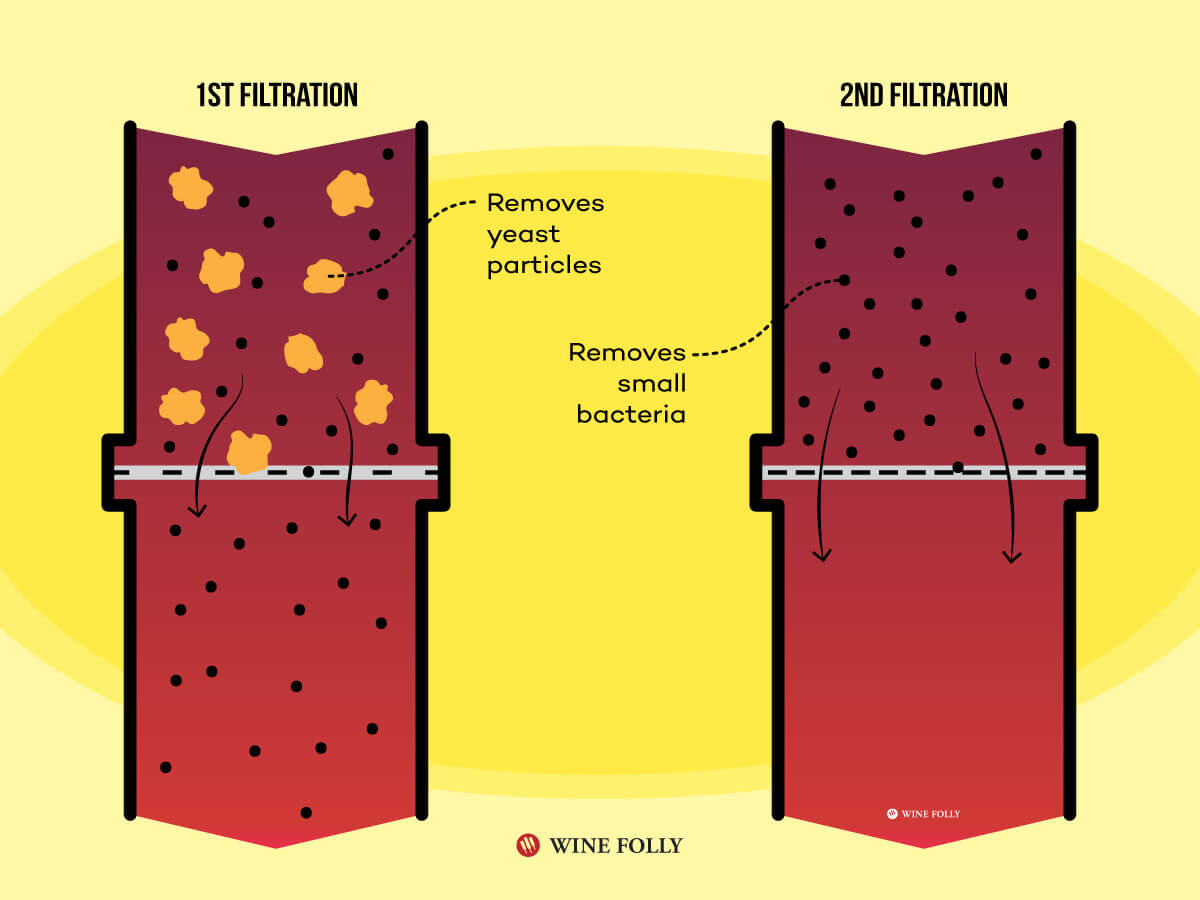
Filtration removes suspended yeast and other microorganisms from the wine. Depending on the winery, filtration may be used to clarify the wine, improve microbial stability, or both. Many commercial wines undergo one or more filtration steps before bottling. The first removes the suspended yeast to clarify the wine, and the second is removes any bacteria before bottling.
Which wines are nearly always filtered:
- Many commercially produced white wines
- Floral or fruity dry white wines
- Most large-scale commercial wines
- Botrytis wines

Unfiltered Wines
Unfiltered wine skips the filtration step; but this doesn’t mean that the wine stays cloudy.
Instead of filtering out the yeast, the wine simply rests for a period of time (no shaking or moving the tanks!). This naturally settles yeast particles through gravity. After this point, the wine gets racked from the lees. During racking, winemakers transfer the clear wine off the settled lees into another vessel.
Given enough time, natural settling can produce wines that appear nearly as clear as filtered wines.
Do the remaining particles change the wine?
Usually not in a noticeable way. Any differences in texture or flavor are more often the result of the overall winemaking approach than the tiny amount of sediment left behind.
Which wines are more commonly available unfiltered?
- Small production red wines
- White wines aged in oak
- Wines with a finished second (malolactic) fermentation
- Dry wines
Unfiltered Wines Are Risky Business
That isn’t to say unfiltered wines are inferior; many are great. However, what happens during the second filtration is very important.
Keep in mind that from a biochemical point of view, wine is a beverage in limbo between juice and vinegar. In other words, finished wine is not a stable medium: it’s in a constant state of change. Also, it’s susceptible to spoilage.
Any bacteria remaining in the wine increases the risk of spoilage.
Winemakers can either remove bacteria by filtration to eliminate microbial activity (the conventional way), or allow for the presence of bacteria, suppressing their activity in other ways (the unfiltered way).
This suppression can be done in the second fermentation (called malolactic fermentation), so that little additional microbial activity occurs in the bottle. The wine develops nutty, creamy characteristics.
The other option is to stabilize the unfiltered wine with a higher dosage of sulfur dioxide (SO₂) (sulfites).

Filtered vs Unfiltered Wine: Co-Existence Is The Answer
Neither approach is inherently better. Filtration is simply another winemaking decision, much like choosing an oak barrel or a fermentation temperature.
Both approaches have their place. Everyone should try out both styles in a tasting to create a personal preference and opinion. We suggest that you do it in a blind tasting setting!