

Oregon is now one of the world’s benchmark regions for Pinot Noir outside Burgundy. But the region can feel complex at first glance. It’s a region that makes far more sense once you’ve seen it.
Here’s how to find the best Oregon Pinot Noir.

On Finding The Best Oregon Pinot Noir
Where To Look?
The majority of Oregon Pinot Noir still comes from the Willamette Valley AVA. Within the Willamette Valley, there are 11 officially recognized sub-AVAs, five of which have been approved in recent years (2019-2022).
- Van Duzer Corridor AVA (established January 2019)
- Tualatin Hills AVA and Laurelwood District AVA (both established in June 2020)
- Lower Long Tom AVA (established December 2021)
- Mount Pisgah, Polk County, Oregon AVA (established July 2022)
Beyond the Willamette Valley
While the Willamette Valley AVA remains the undisputed heart of Oregon Pinot Noir, other regions across the state are gaining recognition for their distinctive expressions of the grape. The Umpqua and Rogue Valleys in Southern Oregon offer warmer-climate styles — typically riper, with richer fruit flavors and softer textures. Within these regions, nested AVAs such as Elkton, Oregon (in the Umpqua Valley), and Applegate Valley (in the Rogue Valley) highlight the growing focus on clonal diversity and site-driven winemaking, underscoring Pinot Noir’s adaptability in unexpected places.
Further north, the Columbia Gorge AVA is a cool-climate region shaped by strong wind patterns, elevation shifts, and diverse microclimates, producing elegant, aromatic wines with vivid acidity and structure.
Altogether, Oregon’s 23 officially recognized AVAs contribute to a stunning diversity of Pinot Noir styles, from lean and age-worthy to plush and fruit-forward, cementing the state’s status as one of the world’s most exciting Pinot-producing regions.
A Trick To Finding Top-Ranking Vineyards
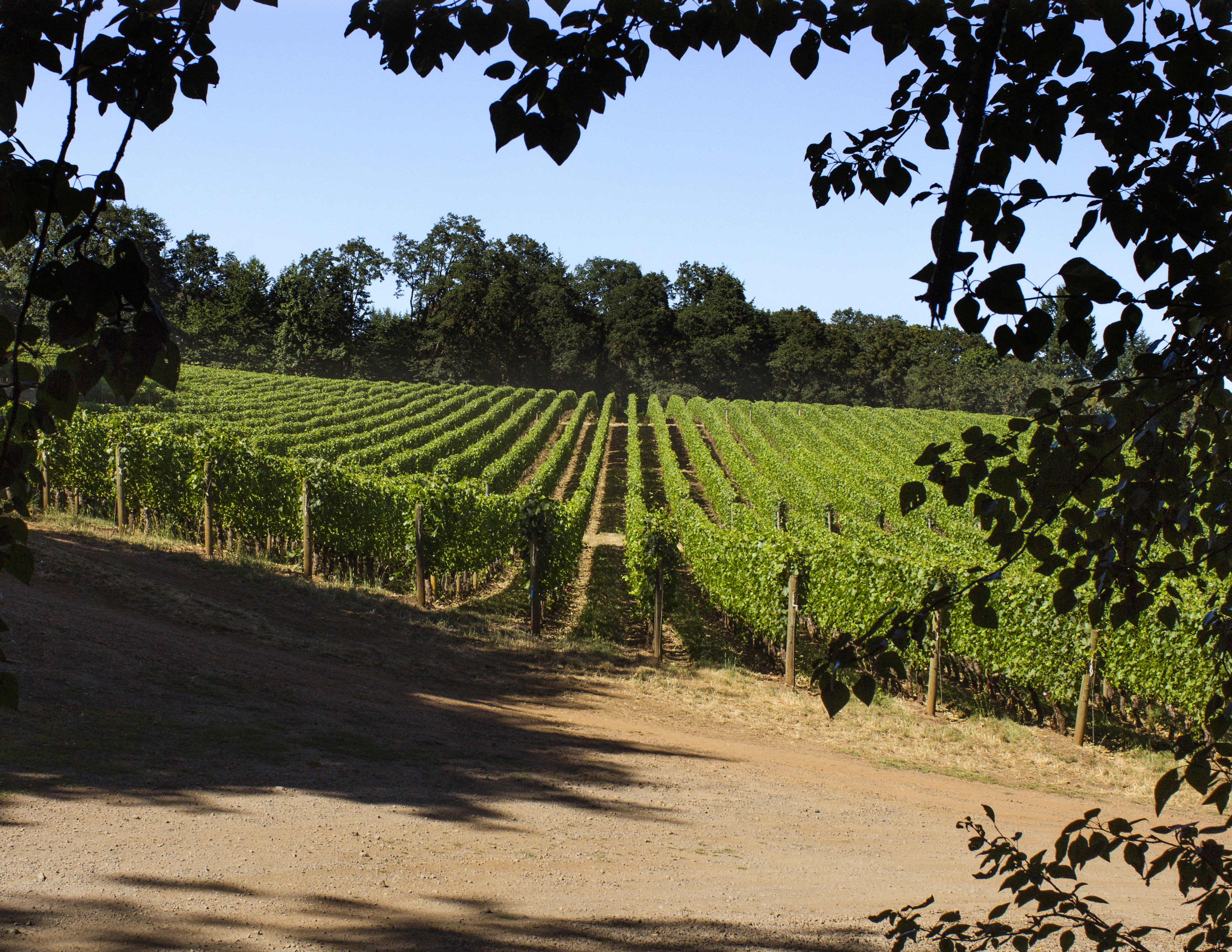
In Oregon, slope direction shapes ripeness. South and southeast-facing vineyards catch more heat, producing riper, more structured Pinot Noir. Oregonians have the French to thank for this, after observing the success of Burgundy – the original homeland of Pinot Noir. The Burgundians realized through trial-and-error that their best vineyard plots were on slopes facing southeast.
A glance at topography maps of the Dundee Hills AVA shows that the same applies to some of Oregon’s top vineyards.
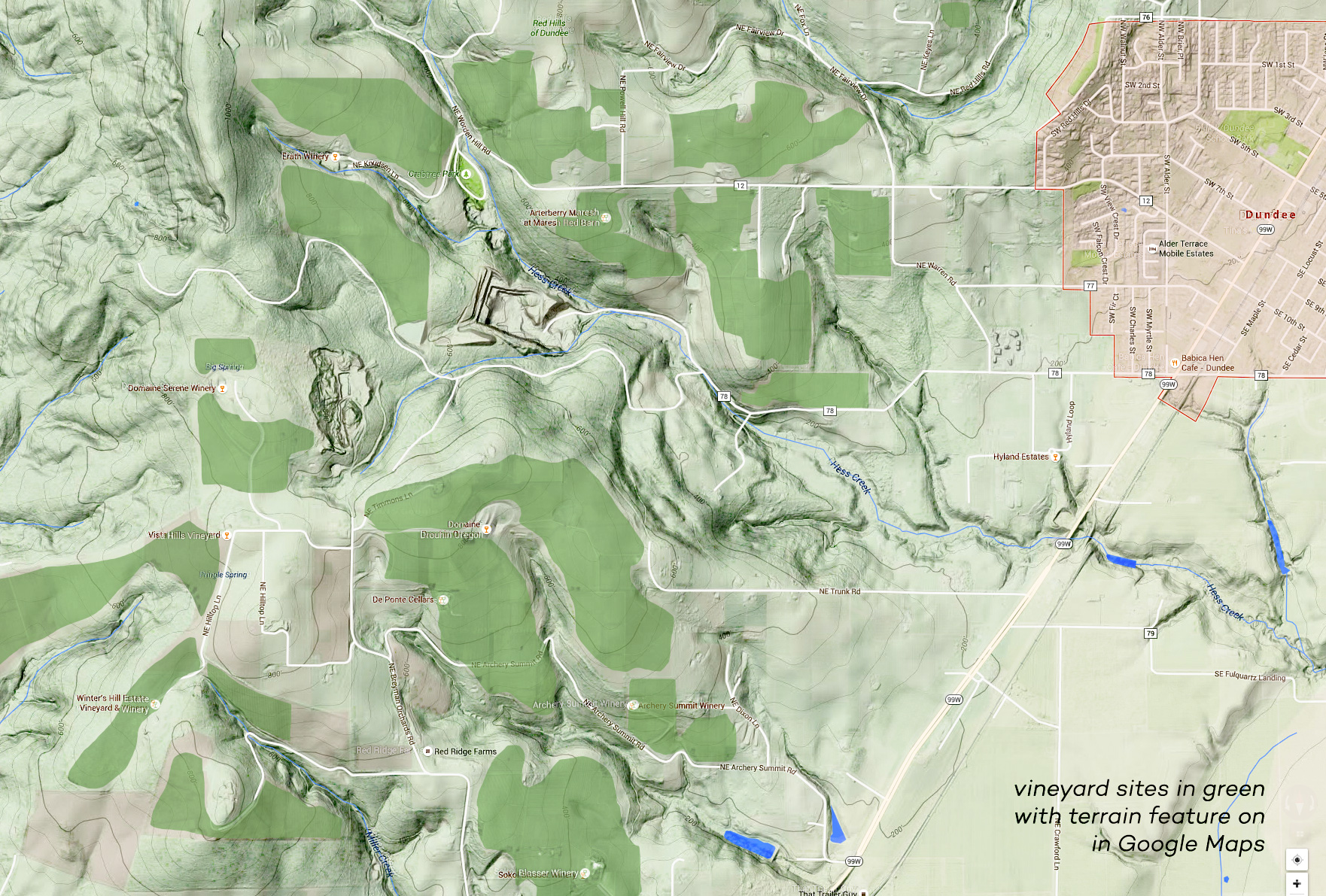
A zoomed-in terrain view looking at the Dundee Hills AVA with vineyards shown in dark green. You can see how some of Oregon’s top vineyards, including Maresh, Domaine Serene, Domaine Drouhin, Sokol Blosser, Archery Summit, etc., are all located on southern-facing slopes.
Zoom in on Dundee Hills with Google Maps
Slope and Sunlight: Orientation Matters
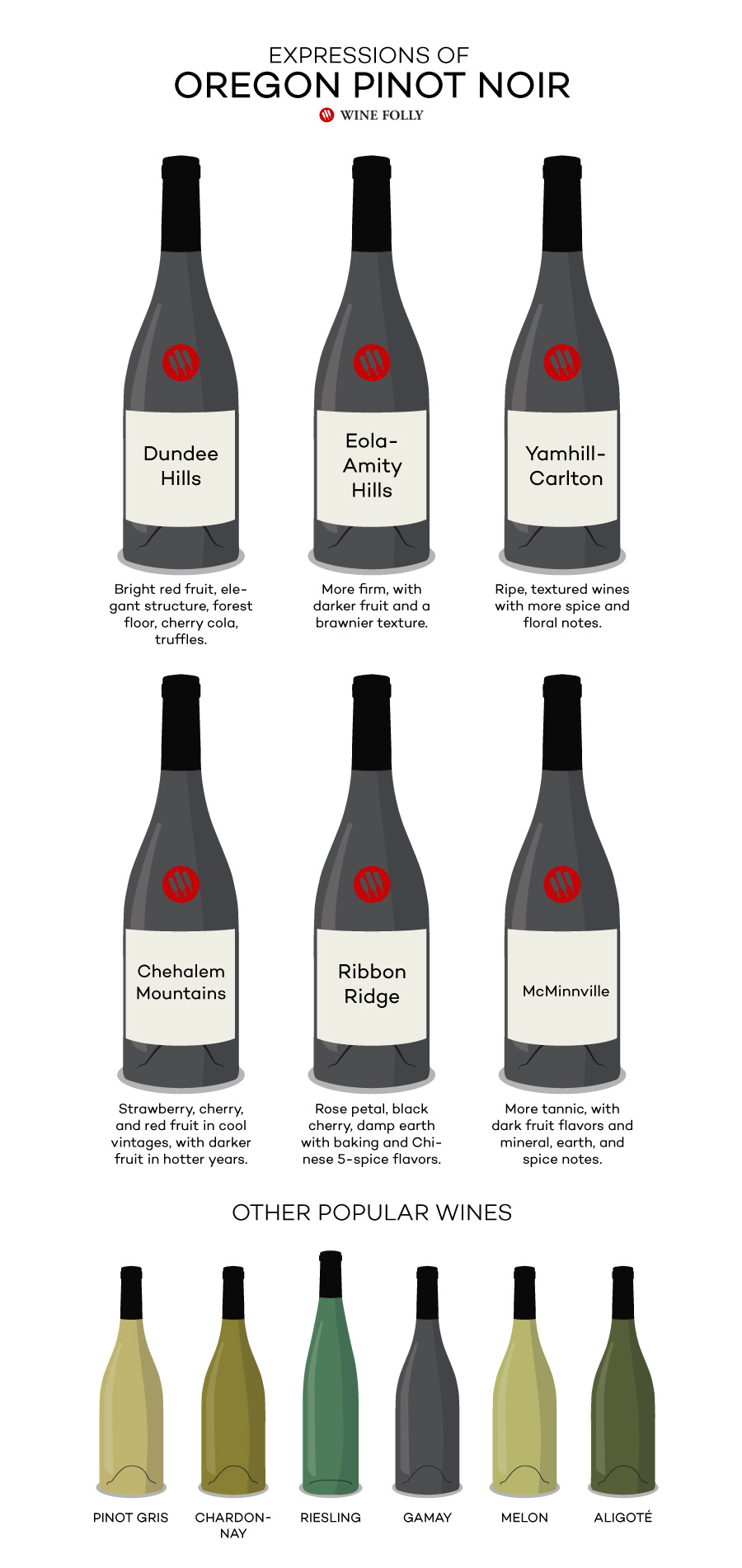
Many of Oregon’s top vineyards are found on south and southeast-facing slopes, maximizing sun exposure in this marginal climate. However, east-facing slopes are increasingly celebrated, especially in places like the Chehalem Mountains, where they catch the gentle morning light and avoid the afternoon heat. This orientation can result in a slower, more even ripening process — ideal for preserving the delicate acidity and aromatic nuance that Pinot Noir is known for.
Vintage Notes for Oregon Wines
Another important thing to keep in mind when finding great Oregon Pinot Noir is paying attention to the vintage. Unlike some hotter climate areas, Oregon wine depends on the weather. The taste can differ significantly between vintages, and while some love this about both Oregon and Burgundy wines, it can be surprising if you’re not aware of what to expect. Cooler vintages produce more tart, elegant, lean wines that will age well, whereas hotter vintages make richer, fruitier and more opulent wines.
- 2024 Many producers describe 2024 as a highly balanced growing season with favorable ripening conditions.
- 2023 A warm, challenging year yielding concentrated, vibrant wines with great structure and acidity.
- 2022 Spring frosts meant a late start to the growing season, but warm temperatures resulted in harvest times returning to average. This led to larger berries because there was a lower overall fruit set – you might see lighter-colored Pinot Noir wines, but still with great flavor and ripeness.
- 2021 A warm vintage with both ripeness and acidity balance. A return to normal.
- 2020 A nearly perfect vintage except for the serious wildfires that smoked up the valley into harvest. The impact of the smoke varied by vineyard.
- 2019 Significant wildfire influence in Southern Oregon. The Willamette Valley fared well with a hot vintage, resulting in riper, softer styles of Pinot Noir.
- 2018 Ripe, quality vintage all around, but hotter than normal. These wines taste great on launch, but look for wines with more whole cluster usage if you’re looking to age your bottles.
- 2017 A wetter start and extreme heat/cool shifts in 2017 resulted in a highly variable vintage with what growers describe as sugar accumulation disorder (SAD – grapes shrivel, lose color, and stay sour). Additionally, smoke taint from forest fires was a concern. Fortunately, good growers took special care this vintage. Seek quality.
- 2016 One of the earliest harvests on record for many sites means fruit set started early, but expect harsher, greener seed tannins and higher overall acidity. Good producers will excel in this vintage and offer age-worthy wines; value options will likely vary.
- 2015 Dry, warm weather all year will yield rich, full-bodied Oregon Pinot with lots of color. Expected to be similar in style to 2014, but low rains and record-breaking hot temperatures may lead to fatter wines.
- 2014 A picture-perfect warm-climate vintage, producing rich, full-bodied Pinot Noir with larger-than-ever production.
- 2013 A very hot year, similar in style to 2006 and 2009, but late rains caused many wines to lose concentration (depending on the producer).
- 2012 A warm harvest year, producing rich, full-bodied Pinot Noir but with a smaller production overall.
- 2011 A very cool year producing lean, elegant wines for aging.
- 2010 A cooler vintage with reduced yields, lighter colored wines that may have been tart on release but will improve with aging.
- 2009 A hot, dry year producing rich but sometimes fat wines with lower acidity (and thus less age-ability).
- 2008 A warm year producing bold, fruit-forward Oregon Pinot Noir wines often noted for subtle cinnamon-spice characteristics.
- 2007 A dry, hot summer followed by rains during harvest produced wines with lower acidity but also without the concentration needed to impress.
- 2006 A hot, dry year producing rich but sometimes fat wines with lower acidity (and thus less age-ability).
- 2005 A warm vintage producing fruit-forward wines that impressed drinkers for five or so years.
2015-2024
2005-2014
Take this information with you and start looking up where your favorite Oregon Pinot Noir wines come from. Then, zoom out to the bigger picture of the region to look for similar areas—you might be surprised at the delights you’ll find.